


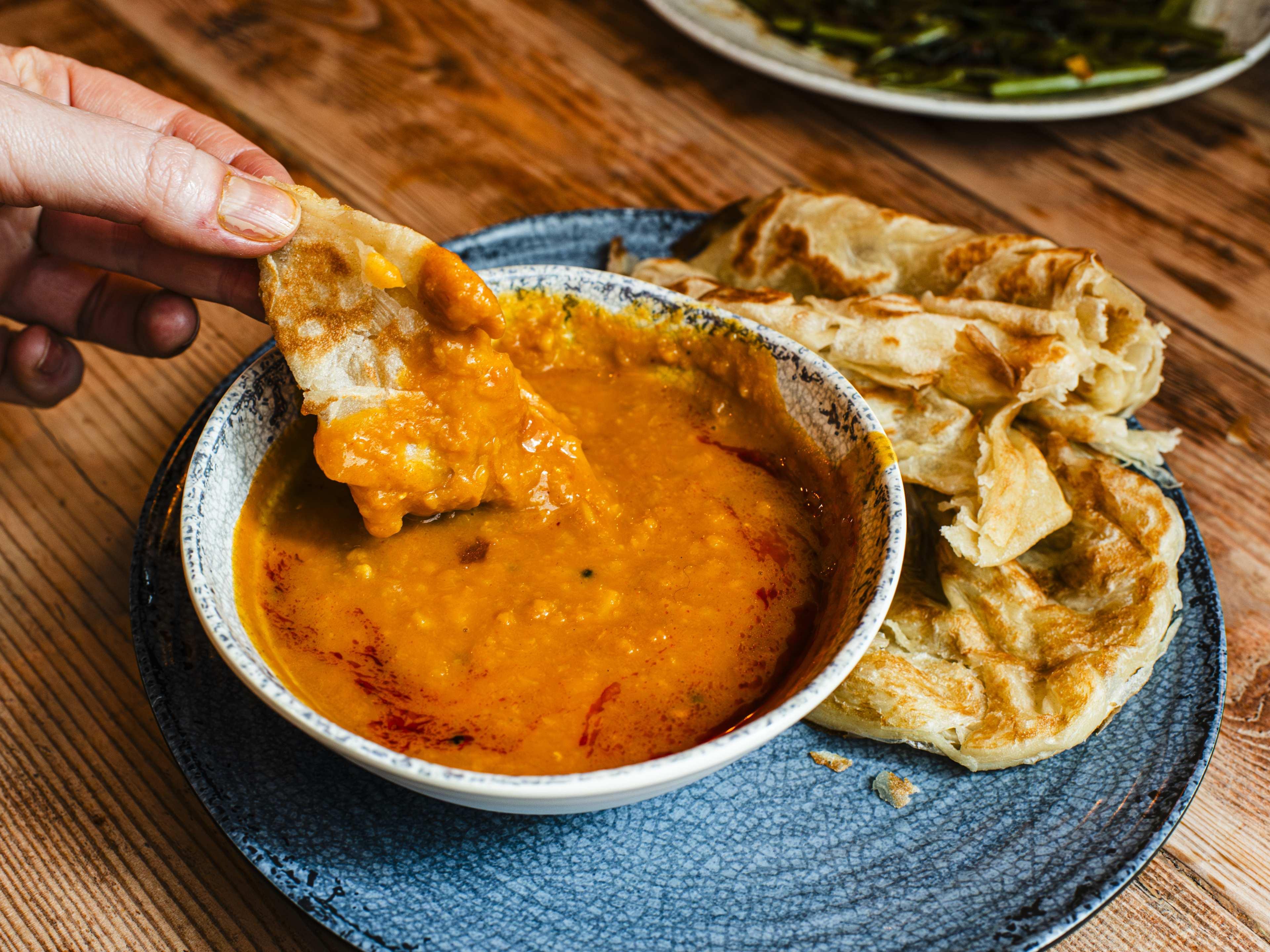
Malaysian Roti Canai with Curried Lentil Dip , famous for its delicate layers, crisp golden exterior, and soft, chewy center. Traditionally made from a simple wheat-flour dough enriched with water, salt, and fat, the dough is stretched remarkably thin, folded repeatedly, and cooked on a hot griddle until beautifully flaky. It is commonly enjoyed for breakfast, brunch, or as a satisfying accompaniment to curries and dhal.This Malaysian-style flatbread is especially delicious when served with a warm curried lentil dip. The creamy lentils, aromatic spices, onions, garlic, ginger, and chilies provide a rich contrast to the crisp and buttery layers of the roti.
Malaysian Roti Canai:
Each piece of Roti Canai can be torn by hand and dipped into the flavorful lentil curry, creating a comforting combination of textures and spices.Although Roti Canai is strongly associated with Malaysian Indian cuisine, its story reflects the multicultural culinary history of Malaysia. Influenced by Indian flatbread traditions and adapted over generations in Southeast Asia, Roti Canai has become a distinctive Malaysian street-food favorite. This homemade version brings that satisfying restaurant-style experience to your own kitchen.
History of Roti Canai:
Roti Canai is closely associated with Malaysian Indian cuisine, particularly the food traditions developed by Indian communities in Malaysia. The word “roti” refers to bread or flatbread, while “canai” has several proposed linguistic origins. The dish is often linked to Indian roti traditions while also reflecting Malaysian culinary development.Indian Muslim communities played an important role in popularizing roti-based dishes throughout Malaysia. Over time, the flatbread became a staple at mamak restaurants and stalls, where it is commonly served with dhal, curry, sambal, or other savory accompaniments.The characteristic preparation technique is one of the most recognizable features of Roti Canai. Skilled cooks stretch and toss the dough until it becomes extremely thin before folding it into layers. When cooked on a hot griddle, the layers separate slightly, producing the flaky texture that makes Roti Canai so popular.
Subscribe to our youtube channel Kitchenpedia for more delicious recipes and hit the like button if you enjoyed this youtubevideo. Share it with your friends and Family.
Roti Canai

Ingredients
For the Roti Canai Dough
- 3 cups (375 g) all-purpose flour
- 1 teaspoon salt
- 1 tablespoon sugar
- 1 large egg
- ¾ cup (180 ml) lukewarm water, plus more if needed
- ¼ cup (60 ml) evaporated milk or regular milk
- 2 tablespoons neutral cooking oil
- ½ cup (120 ml) vegetable oil or melted ghee, for soaking and cooking
For the Curried Lentil Dip
- 1 cup (200 g) red lentils, rinsed
- 3 cups (720 ml) water or vegetable stock
- 2 tablespoons vegetable oil
- 1 medium onion, finely chopped
- 4 cloves garlic, minced
- 1-inch piece fresh ginger, finely grated
- 1–2 green chilies, finely chopped
- 1 medium tomato, chopped
- 1 teaspoon mustard seeds
- ½ teaspoon cumin seeds
- ½ teaspoon turmeric powder
- 1 teaspoon ground coriander
- 1 teaspoon ground cumin
- 1 teaspoon Malaysian or South Indian curry powder
- ½ teaspoon chili powder, optional
- ½ teaspoon black pepper
- 8–10 curry leaves
- 1 small cinnamon stick
- 2 cloves
- 1 small bay leaf
- ½ teaspoon tamarind paste
- ½ teaspoon sugar, optional
- Salt, to taste
- ½ cup coconut milk, optional
- Fresh cilantro, chopped, for garnish
- Lime wedges, for serving
Instructions
- Add the flour, salt, and sugar to a large mixing bowl.Whisk briefly to distribute the ingredients evenly.
- Make a well in the center of the flour.Add the egg, lukewarm water, milk, and 2 tablespoons of oil.Mix with a spoon or your hands until a soft dough begins to form.
- Transfer the dough to a lightly oiled work surface.Knead for approximately 8–10 minutes, until the dough becomes smooth, soft, and elastic.The dough should feel supple rather than stiff.If it feels dry, add a teaspoon of water at a time.
- Divide the dough into 6–8 equal portions.Shape each portion into a smooth ball.
- Place the dough balls in a shallow container.Pour enough vegetable oil or melted ghee over them to coat the surfaces generously.Cover the container tightly.
- Allow the dough to rest for at least 4 hours.For an especially relaxed and stretchy dough, refrigerate it overnight and bring it back to room temperature before stretching.The long resting period helps develop the characteristic thin, stretchy texture.
- Place the rinsed red lentils and water or vegetable stock in a saucepan.Bring to a boil, then reduce the heat.Simmer for approximately 15–20 minutes, or until the lentils are soft and beginning to break down.Set aside.
- Heat the oil in another saucepan over medium heat.Add mustard seeds and cumin seeds.When the mustard seeds begin to pop, add the cinnamon stick, cloves, bay leaf, and curry leaves.Cook for approximately 30 seconds.
- Add the chopped onion.Cook for 5–7 minutes, stirring occasionally, until softened and lightly golden.Add garlic, ginger, and green chilies.Cook for another 1–2 minutes.
- Add the chopped tomato, turmeric, coriander, cumin, curry powder, chili powder, and black pepper.Cook for approximately 3–5 minutes, until the tomato softens and the spices become fragrant.
- Pour the cooked lentils into the spiced onion mixture.Stir thoroughly.Add additional water or stock if the mixture is too thick.
- Stir in the tamarind paste and optional sugar.Season with salt.Simmer for another 8–10 minutes, allowing the flavors to combine.
- For a richer and creamier lentil dip, stir in the coconut milk.Simmer gently for another 2–3 minutes.Do not boil vigorously after adding the coconut milk.Taste and adjust the salt, chili, tamarind, or curry powder as needed.
- Generously oil a large, smooth work surface.Take one rested dough ball and place it on the oiled surface.Keep the remaining dough covered so it does not dry out.
- Using your fingertips, gently flatten the dough.Continue stretching it outward until it becomes extremely thin.Ideally, you should be able to see the work surface through parts of the dough.Do not worry if a few tiny holes appear.
- Brush or drizzle a small amount of oil or melted ghee over the stretched dough.This helps separate the layers during cooking.
- Fold the dough inward from several sides to form a layered square or rectangular parcel.Gently press it together without flattening it too much.Allow the folded dough to rest for approximately 5–10 minutes.
- Gently press or stretch the folded dough until it becomes approximately ¼ inch thick.Keep the shape somewhat irregular rather than trying to make it perfectly round.
- Place a heavy skillet, cast-iron pan, or flat griddle over medium-high heat.Lightly grease the surface.
- Place the flattened dough onto the hot pan.Cook for approximately 2–3 minutes, or until the underside becomes golden.Flip the roti.Cook the second side for another 2–3 minutes.Add a little oil or ghee around the edges if necessary.
- Continue flipping occasionally until both sides are golden brown and crisp.The outside should be flaky while the inside remains soft and layered.
- Once cooked, remove the roti from the pan.While it is still hot, gently clap or squeeze the sides of the roti between your hands to loosen the layers.Be careful because the roti will be hot.Repeat with the remaining dough.
- Serve the Roti Canai immediately while hot.Pour the warm curried lentil dip into a serving bowl and garnish with fresh cilantro.Serve with lime wedges for a bright finishing flavor.
Notes
Tips for Malaysian Roti Canai :
- Rest the dough overnight when possible for easier stretching and a more delicate texture.
- Keep your hands and work surface well-oiled when handling the dough.
- Stretch the dough gradually instead of pulling it aggressively.
- Use a neutral oil with a high smoke point for frying.
- Avoid overcrowding the pan when cooking multiple rotis.
- Keep cooked rotis covered with a clean towel while preparing the remaining ones.
- Adjust the lentil dip with extra water if it becomes too thick.
- Add fresh lime juice just before serving for a brighter and more balanced curry flavor.
FAQ’s for Malaysian Roti Canai :
1. What is Roti Canai?
Roti Canai is a popular Malaysian flatbread made from wheat-flour dough that is stretched thin, folded into layers, and cooked on a griddle. It is known for its crisp exterior and soft, flaky interior.
2. Is Roti Canai the same as Indian roti?
They are related through South Asian flatbread traditions, but Roti Canai has developed its own distinctive preparation, texture, and place in Malaysian cuisine.
3. Why does Roti Canai need to rest for so long?
Resting allows the gluten in the dough to relax. This makes the dough much easier to stretch into a very thin sheet without immediately shrinking back.
4. Can I prepare Roti Canai dough the night before?
Yes. Overnight resting can be very convenient and can make the dough easier to stretch. Refrigerate the oiled dough balls and bring them back to room temperature before shaping.
5. Can I make Roti Canai without eggs?
Yes. The egg can be omitted. The texture will be slightly different, but you can still make a delicious layered flatbread.
6. What lentils are best for the dip?
Red lentils are particularly convenient because they cook quickly and naturally break down into a creamy consistency. Yellow split lentils can also be used.
7. Can I make the lentil dip ahead of time?
Yes. The lentil dip can be prepared ahead and refrigerated. Reheat it gently and add a little water or stock if it becomes too thick.
8. How should leftover Roti Canai be reheated?
Reheat it in a dry or lightly oiled skillet over medium heat. This helps restore some of its crispness better than microwaving alone.
Conclusion:
Malaysian Roti Canai with Curried Lentil Dip is a wonderfully satisfying combination of crisp, flaky flatbread and aromatic, creamy lentil curry. The secret to great Roti Canai lies in the soft dough, generous resting time, careful stretching, and repeated folding that creates its signature layers.
The curried lentil dip adds warmth and depth with onions, garlic, ginger, chilies, curry leaves, and fragrant spices. Its creamy texture makes it the perfect partner for tearing pieces of hot Roti Canai and dipping them straight into the curry.
Although stretching the dough takes a little practice, the result is well worth the effort. Once you master the technique, homemade Roti Canai can become a delicious centerpiece for breakfast, brunch, or a Malaysian-inspired family meal.